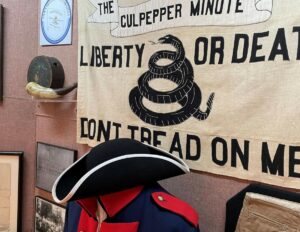
Culpeper Minute Men: Icons of Independence
Burford’s Massacre and Col. Abraham Buford
Written by: Jim Bish
It is considered the worst massacre of Patriot troops during the Revolution, as British and Loyalist troops under the command of Lt. Col. Banastre Tarleton used both shot and bayonets to slaughter 113 Patriots and severely wound 153 others. The 1780 Waxhaws Massacre has an important direct link to Culpeper. Abraham Buford was born to a well to do family, John and Judith (Early) Buford, in Culpeper County in 1747. His family had long lived in the Orange and Culpeper area having immigrated from Middlesex County, Virginia in the early 1730s. During that time his family was intermarried into many local families, including the Early and Kirtley families. Abraham’s older brother Thomas served as an officer in the Virginia Regiment with the Braddock Expedition of 1755 during the French & Indian War. Later in the 1774 Lord Dunmore’s War, Abraham’s brother Thomas served as a Captain in the Bedford Militia. Abraham and their younger brother Simeon, also served in that war as members of their home county of Culpeper. During that conflict, in the Battle of Point Pleasant on October 10, 1774, Thomas Buford suffered a mortal wound.
As hostilities began the Revolutionary War in 1775, Abraham recruited a company of men for the formation of the Culpeper Minute Battalion created by the 3rd Virginia Convention. Most of Buford’s recruits lived close by in the southwest part of Culpeper County. In that area there were many former Germanna Colony descendants, some who served in his company. The Culpeper Minute Battalion turned out to be the only fully manned minute battalion formed in 1775 resulting in their deployment to Williamsburg in October 1775 at the request of Col. Patrick Henry. Almost immediately after arriving in Williamsburg Buford was singled out for having the most expert riflemen in the battalion. His 50-man company was selected to defend Hampton from attack by the Governor Dunmore’s naval forces. About nine o’clock on the evening of October 26th, Col. Woodford and Capt. Buford’s volunteer company of Culpeper riflemen, departed Williamsburg on horseback for the 30-mile ride to Hampton. Traveling in a rainstorm all night on horses provided by the citizens of Williamsburg, they arrived at daybreak on October 27th, just in time to deploy and return long range rifle fire to counter the three and four-pound cannons of four tenders that entered Hampton Harbor. This fire resulted in British and Loyalist casualties and the capture of one tender and crew. This was the reported first use of the rifle during this campaign to prevent British naval tenders from approaching the shore. One contemporary article referred to the Culpeper riflemen sent to Hampton as, “50 fine riflemen.” Buford’s Company would prove vital in the later battles against Dunmore’s royal and loyalist troops at the patriot victories at Great Bridge and the burning of Norfolk. Buford’s actions with the Culpeper Minutemen allowed Virginia to become liberated, resulting in their declaring independence in May 1776, two months before that of the Second Continental Congress in July.
After the Culpeper Minute Battalion was disbanded in the Spring of 1776 Buford continued in the fight. He served with Washington’s Army as an officer in the 14th, 5th, and 11th Virginia Regiments during the battles around Philadelphia (Battle of Brandywine and Germantown) and in New Jersey (Battle of Monmouth). In 1779, Buford, now a colonel, was placed in command of the 3rd Virginia Detachment, part of the 2nd Virginia Brigade. In 1780 he took his detachments south in order to reinforce Charleston, South Carolina, then under siege by the British. Buford’s column failed to arrive before the sudden surrender of Charleston resulting in Buford’s decision to quickly turn back north before his capture. Thinking he could escape before the main British forces caught up to him, Buford refused an initial demand to surrender. It was not long before some of Lt. Col. Banastre Tarleton British and Loyalist forces caught up to the rear of Buford’s column of 350 Virginia Continentals in an area called Waxhaws, near Lancaster, South Carolina on May 29. Realizing they could not escape, Buford attempted to surrender as many of Buford’s men threw down their arms. During the surrender negotiations, a shot rang out toward Tarleton, and the horse he was riding was killed, temporarily trapping him under his horse. Thinking Tarleton was killed, chaos followed as Tarleton’s forces unleashed their attack against the surrendering Continentals. Tarleton’s men shot and bayoneted 113 Patriots to death and severely wounded 153 others. Colonel Buford rallied his survivors and some managed to escape. After the battle, nearby settlers aided survivors and buried American soldiers in a long trench.
This event, afterwards known at the “Waxhaw massacre” horrified the South and led to the Patriot battle cry, “Tarleton’s Quarter!” (meaning to take no prisoners). The event also inspired the cruel British villains in the 2000 movie The Patriot.
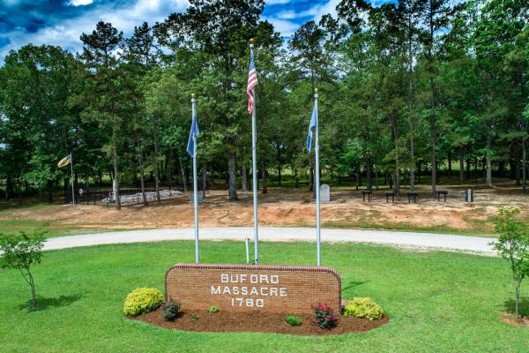
Buford’s Massacre monument in South Carolina
Afterwards, the “Waxhaws Massacre” became the subject of an intensive propaganda campaign by the Continental Army to bolster recruitment and incite resentment against the British. Colonel Buford rallied his survivors and continued to lead them in the field for another seven months. His command was filled with Continental Line and State Line veterans then known as “Buford’s Battalion,” or sometimes called “Buford’s Regiment.” By January 1781, however, Colonel Buford was no longer with his command. Illness had taken its toll on him and he was sent to gather supplies in Salisbury, North Carolina. He returned to Virginia the following month and continued in an administrative position there for the remainder of the war. Buford’s Battalion fought on as Major Thomas Ridley assumed command of the battalion. Those who remained in Buford’s Battalion with Ridley in 1781 marched with General Greene during the “Race to the Dan.”
After the war, Buford family members, including Kirtley and Early relatives eventually moved to the Bluegrass region of Kentucky on military bounty lands in excess of several thousand acres. Burford helped found that state’s race-horsing industry and where he lived until his death at his home which he called “Richland” (National Register of Historic Places) in Scott County, Kentucky on June 30, 1833. He and his wife Martha (McDowell) Buford were originally buried at their estate, but they were moved when the Georgetown Cemetery opened in Scott County, KY. On Flag Day, June 14, 2006, descendants of Lt. Col. Banastre Tarleton returned Col. Buford’s regimental flags, which were taken at the Waxhaw Massacre, and sold them at Sotheby’s in New York for over $5,000,000. Abraham Buford was one of six sons of John and Judith (Early) Buford, all of whom served with distinction as officers during the American Revolution. Their Civil War descendants include US Major Generals John Buford, Jr., noted for his service at the Battle of Gettysburg; Napoleon Bonaparte Buford; and CS General Abraham Buford.
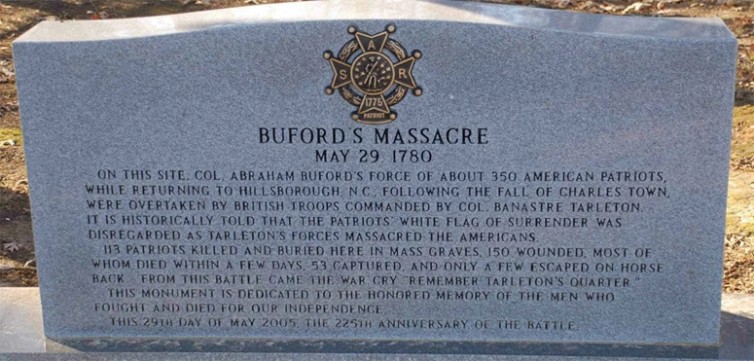
Buford’s Massacre monument in South Carolina
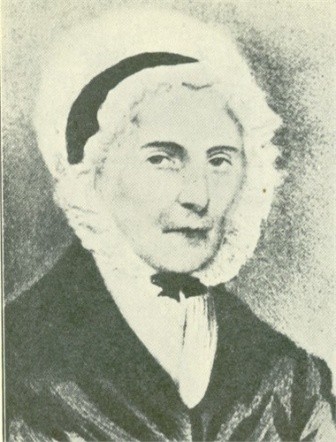
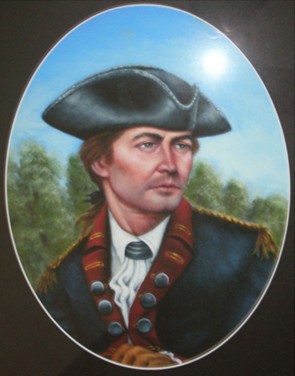
Martha (McDowell) Buford and Col. Abraham Buford
The above images reveal a sketch made of Martha (McDowell) Buford and that of Col. Abraham Buford is a forensic portrait of Revolutionary War Patriot Colonel Abraham Buford, and is one of the newest acquisitions of the Lancaster County Historic Courthouse Museum in South Carolina. There is an historic marker at the corner of Hwy 9 east of Lancaster and Hwy 522 and a park at the site of the mass grave of the Patriot fallen on Hwy 522 south of Hwy 9. The park has interpretive signs and memorials and is maintained by the Friends of the Buford Massacre Battlefield. There is no known likeness of Col. Buford. A ‘forensic’ portrait is one made from evidence rather than from life. In the case of this portrait, the artist, Thomas Kelly Pauley, studied likenesses of known Buford descendants and combined them for the portrait.
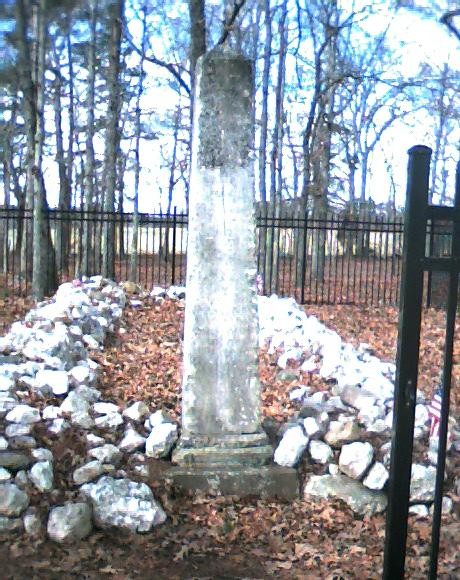
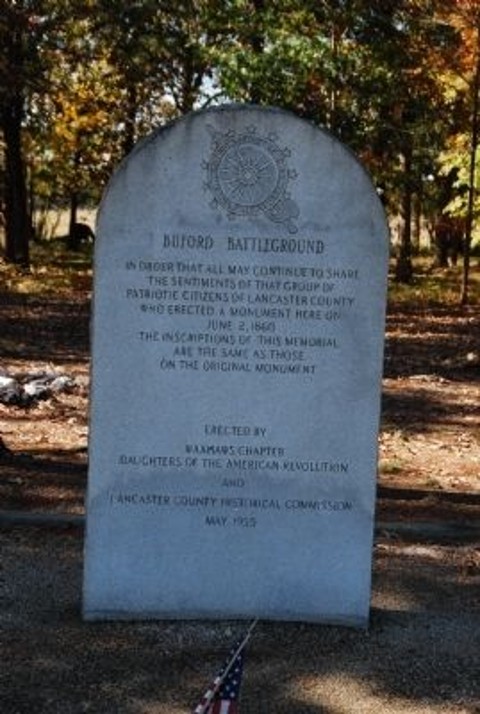
Two monuments now mark the Burford Battleground. Shown above is a white monument ten feet tall, erected on June 2, 1860, marked the gravesite of American soldiers who died during the battle. Nearly the entire command of Col. Buford were either killed or wounded. Here many of their lives were ended in the service of their country. The cruelty and barbarous massacre committed on this occasion by Tarleton and his command after the surrender of Col. Buford and his regiment originated the war cry “Remember Tarleton’s Quarters” a British historian confesses at this battle the virtue of humanity was totally forgot. This marker was gradually damaged over time by souvenir hunters who chipped off pieces, which led local authorities to erect a new monument shown below on May 1, 1955, bearing the same inscription. This site was added to the United States National Register of Historic Places in 1990.
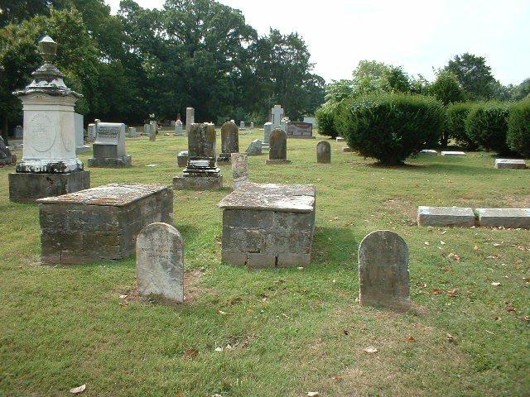
The graves of Abraham and Martha (McDowell) Buford, located in the Georgetown Cemetery, Scott County, KY.